What if Babies Could Receive Jaundice Treatment While Being Held?
Jul 28, 2026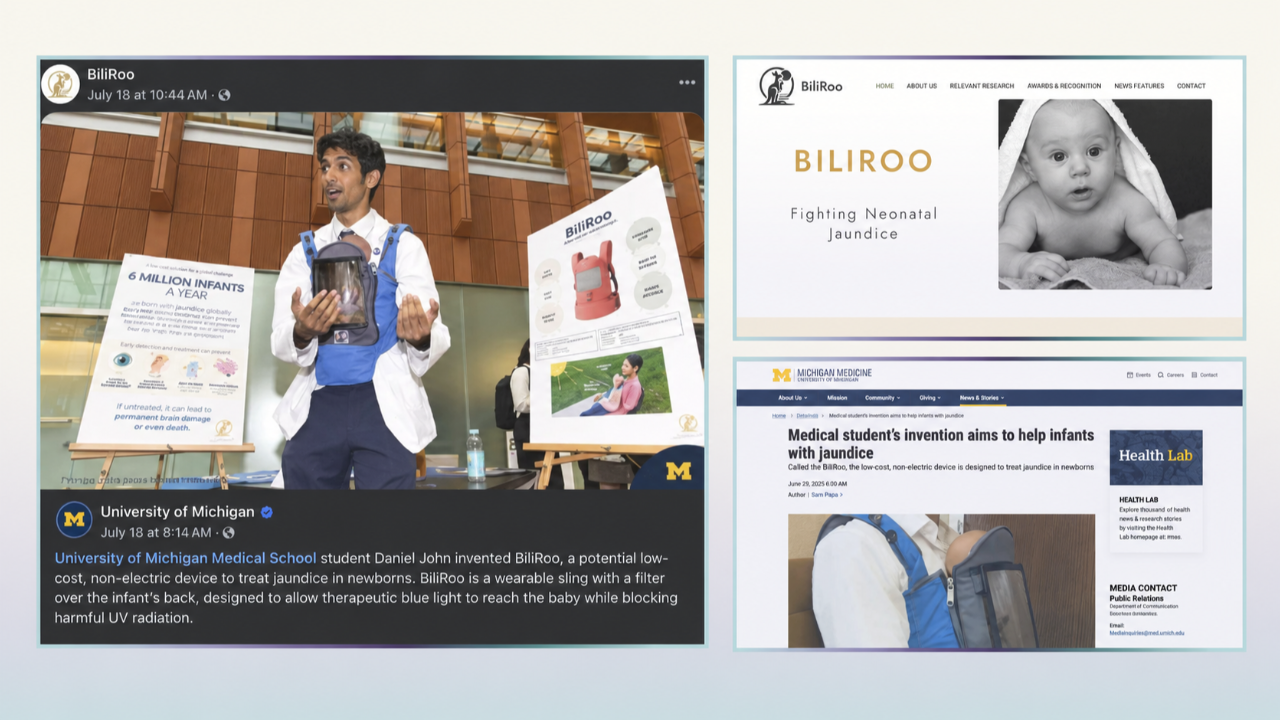
Every so often, someone creates something new from something old and it just feels like it was made for this community.
The BiliRoo is one of those things. It lives where two of many of the babywearing community’s deepest values meet: the physiology of holding a baby close and the belief that every family deserves access to care, even when a hospital, reliable electricity, and specialized equipment are not nearby.
BiliRoo was invented by Daniel John, a University of Michigan medical student who began sewing early prototypes while studying mechanical engineering at Calvin University. This little tidbit surprised me, as we'd helped the M-HEAL engineering team a few years back on a different baby carrier project. I was certain that it was developed through that project. However, that isn't the case. John's relatives taught him some of the basics of sewing, and his undergraduate dorm room gradually filled with baby carriers, sewing kits, and what would eventually become a medical device.
Born in Nepal, John wanted to develop simple, affordable medical devices for places where electricity and specialized equipment cannot always be assumed. The device has since received recognition from the Michigan Business Challenge, the National Inventors Hall of Fame, the United States Patent and Trademark Office, the American Society of Mechanical Engineers, and the Rice Business Plan Competition. But let's look closer.
• • •
What is the BiliRoo?
The BiliRoo is a wearable phototherapy device, designed to treat neonatal jaundice and promote parental involvement. Picture a buckle carrier with a special filter positioned over the baby’s back. The filter is designed to allow the therapeutic blue light from the sun to reach the baby while blocking harmful ultraviolet radiation. Thus removing the need to rely on electrically powered equipment.
The BiliRoo is being developed as a low-cost, non-electric way to deliver filtered sunlight phototherapy while the baby remains against the caregiver’s body.
The name brings those two pieces together: Bili for bilirubin and Roo for kangaroo care.
The idea is not simply to make phototherapy portable. It's to explore whether treatment and kangaroo care can happen at the same time.
• • •
Why the kangaroo care piece matters
This is the part that will probably feel especially meaningful to babywearing educators.
Phototherapy can require a newborn to spend extended periods under a light source. Although feeding and caregiving breaks may still happen, conventional phototherapy equipment is not designed with continuous skin-to-skin contact in mind.
Kangaroo care supports closeness and connection while helping newborns maintain body temperature and physiological stability. Research has also associated it with calming, bonding, and support for milk production, particularly for premature and medically vulnerable newborns.
After speaking with several doctors, John asked an important design question: could a baby receive filtered sunlight phototherapy without automatically giving up the benefits of being held close?
Focusing on treatment and closeness not needing to be designed as opposites.
• • •
But what has actually been studied?
A feasibility study of the BiliRoo was published in Pediatric Research in January 2026. It was a bench study and the researchers tested the device outdoors using light-measuring equipment. No newborns participated in this stage of the research.
The researchers measured whether two different filters allowed enough therapeutic blue light to pass through while blocking ultraviolet radiation. In that bench model, both filters blocked more than 99% of the measured UV-A radiation, and the average blue-light levels reached the threshold used for intensive phototherapy across several carrier angles.
Those results are encouraging, but they do not yet tell us whether the BiliRoo safely and effectively lowers bilirubin levels in newborns. The researchers noted that studies involving infants are still needed to examine temperature, comfort, usability, clinical safety, and effectiveness.
Michigan Medicine reported on June 29, 2026, that the next step was a clinical trial.
An important distinction: filtered sunlight phototherapy has previously been studied as a treatment for newborn jaundice. What has not yet been clinically established is delivering that treatment through the wearable BiliRoo device.
• • •
What this does not mean
A regular baby carrier is not a treatment for jaundice. No wrap, sling, or structured carrier currently available to families should be presented as a substitute for medical evaluation or phototherapy.
Newborn jaundice can range from mild and self-resolving to medically urgent. Families who are concerned about jaundice should work directly with their baby’s healthcare team and follow the treatment plan they are given.
The BiliRoo is a medical device still under development. It just happens to use a carried position.
• • •
What it signals for the babywearing field
Perhaps the most meaningful part of this story is not the device on its own. It is the fact that researchers and engineers are taking the carried position seriously enough to build medical technology around it.
Holding a newborn close is not merely a nice thing to do. For the baby, holding has physiological consequences. Those realities are important enough to be considered during the design of medical care.
Whether the BiliRoo eventually becomes widely available will depend on what future clinical research shows. For now, it represents a thoughtful and hopeful question: when we design treatment for newborns, can we protect access to care without unnecessarily designing the caregiver out of the experience?
• • •
Read more:
Medical student’s invention aims to help infants with jaundice
Michigan Medicine Health Lab
Read the BiliRoo bench feasibility study
Pediatric Research